Portfolio Tracking
How to track family investments in India: one household, one view
A practical guide to household investment tracking for Indian families — how to organize accounts across members, review allocation, and see one clear number without five apps.
On this page▼
- Why family portfolios naturally get scattered
- What a household investment ledger looks like
- One account block per member
- Joint accounts and HUF
- How to structure family investment tracking
- Step one: build an account inventory
- Step two: assign each account to its owner
- Step three: track contributions separately, totals together
- What to review at the household level
- Common patterns in Indian family portfolios
- Moving from scattered apps to one household view
For most Indian households, the investment picture is scattered by design. One SIP runs under a spouse's name because the bank account was linked that way. A parent's PPF is in a post-office account nobody has looked at recently. The family's EPF and NPS live in employer-linked portals. A minor's sukanya samriddhi account gets topped up once a year and then forgotten. And somewhere in a shared document folder, there is a spreadsheet that was accurate in 2023.
The problem is not that any one account is hard to track. The problem is that there is no default place where the household total lives. Tracking family investments in India is the work of connecting those separate accounts into one view without losing the detail that belongs to each member.
Why family portfolios naturally get scattered
Several structural reasons push household investments apart.
Account ownership follows tax and regulation. Every PAN-linked investment account — a demat, a folio, an EPF member ID, a PPF passbook — belongs to one person. There is no regulatory shortcut that lets a family hold everything under a single umbrella account. Folios, UIDs, UAN numbers, and PRAN numbers are all individual identifiers.
Contributions follow whoever has the income at a given time. A bonus deploys to one person's account. A corporate NPS top-up lands in one PRAN. A post-retirement family member may no longer be contributing anywhere new. The timing and source of money are different per member.
Products were designed in silos. The EPFO portal shows only a member's own UAN. The NPS trust portal shows only a subscriber's PRAN. Mutual fund RTAs show folios by PAN. None of these systems was built to present a family view; that is work the household has to do on its own.
The consequence: many Indian families estimate their total wealth rather than measure it. The rough number they carry in their heads is somewhere between optimistic and inaccurate, because at least one account is stale and one corpus — usually a parent's — is not in the picture at all.
What a household investment ledger looks like
A clean household ledger has two levels.
One account block per member
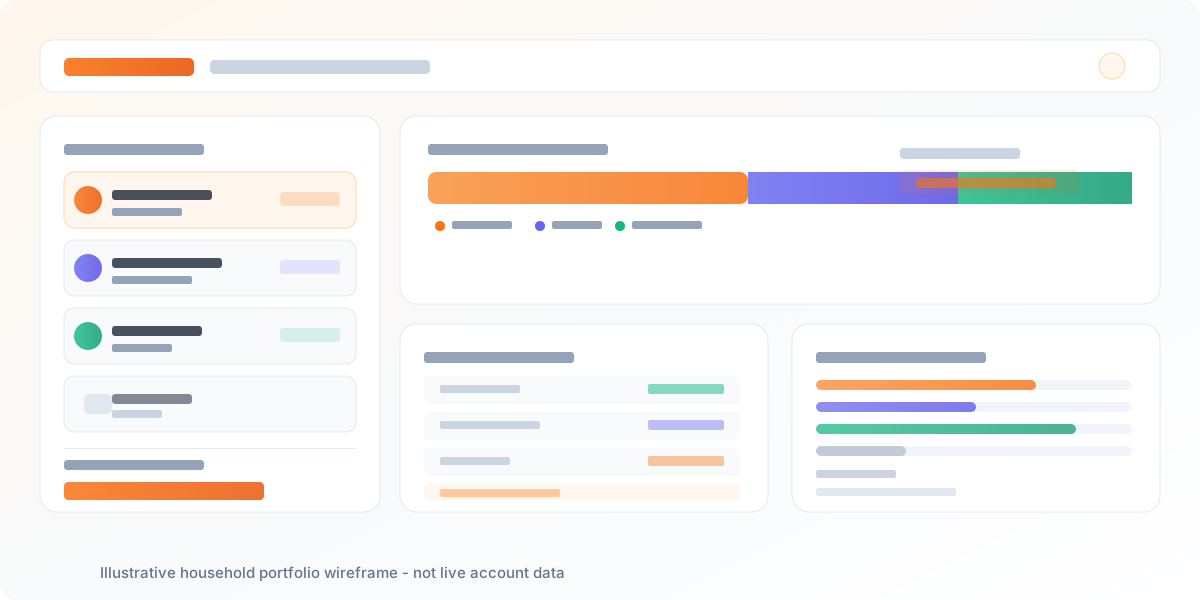
Each adult member of the household gets their own block: their PAN, their accounts (demat, MF folios, NPS PRAN, UAN, PPF account, bank FDs), and the current value of each. This is the member-level view. It matches the regulatory reality: each account is individually owned.
For dependent members or children, the block works the same way. A minor's sukanya samriddhi or a child's guardian-controlled MF folio is assigned to that member.
Joint accounts and HUF
Some families have joint demat accounts, joint mutual fund folios, or fixed deposits with a spouse or parent as a joint holder. The most practical tracking rule is to log joint accounts under the primary or first-named holder, with a note that it is jointly held. When calculating household net worth, include it once — not once per holder.
If the family has a Hindu Undivided Family (HUF) entity, treat it as a separate member in the tracker. An HUF has its own PAN and can hold its own investments, fixed deposits, and property. Merging HUF assets into an individual member's block creates a misleading picture and complicates reconciliation at tax time.
How to structure family investment tracking
Step one: build an account inventory
The first task is to list every account in the household with three fields: account type, institution, and owner name or PAN. This is the foundation. Many families skip it and go straight to balances. The inventory matters because it is the check-list you use every quarter — if a statement is missing, the inventory tells you which institution to follow up with.
A typical dual-income Indian household might have:
- Two demat accounts at different brokers
- Three to five MF folios across both members (direct plans, old distributor plans, ELSS for 80C)
- Two UAN-linked EPF accounts (one per employer history per member)
- One or two NPS PRANs (employer-linked, with or without voluntary top-ups)
- One or two PPF accounts at a bank or post office
- Bank FDs in one or more institutions
- A possible parent's PPF, FD, or senior citizens savings account if managed within the household
That is potentially twelve to fifteen separate positions across five or six institutions, under two or more PANs.
Step two: assign each account to its owner
Every row in the tracker should have an owner field. Do not create a "family" category that mixes legal ownership. You can roll up to household total at the reporting layer, but the ownership layer must be clean.
This matters for three practical reasons. First, nominee and succession documentation follows ownership. Second, tax reporting — LTCG, STCG, dividend income — is PAN-specific. Third, if the household financial situation changes, individually tagged accounts are easier to separate and review.
Step three: track contributions separately, totals together
When a new investment happens — a top-up to an NPS account, a fresh SIP installment, a PPF deposit before March 31 — log it under the right member. The mutual fund tracker, EPF tracker, NPS investment tracker, and PPF tracker each have their own contribution patterns.
The household total is a roll-up, not a primary number. Review it for asset allocation and net worth. Review individual accounts for contributions, limits, and product-level performance.
What to review at the household level
Once the ledger exists, the household-level review is actually short. You are looking for three things.
Asset allocation across the whole family. What percentage of the household's investable wealth is in equity, debt, and policy-backed instruments? This number almost always looks different from any individual member's allocation. A spouse with a conservative EPF-heavy portfolio and a spouse with an equity-heavy direct stock account can produce a combined household exposure that neither person fully sees when they look at their individual app.
Retirement wrapper contributions. Are the annual limits being used sensibly across NPS, PPF, and EPF voluntary top-up? Are there folios that have been ignored for more than a year? Are contributions front-loaded or back-loaded in the financial year?
Stale or orphaned accounts. An old employer's EPF that was not transferred, a folio in an AMC that was never brought under the active folios, a minor's account that has not been reviewed since opening — these show up as gaps in the inventory review.
You can use Invesh.io to track each of these accounts in one place and view the household total without manually adding up values from multiple portals.
Common patterns in Indian family portfolios
Dual-income households with synchronized retirement timelines. Both spouses have NPS or EPF, but often in different asset mixes. The household view reveals the blended equity percentage, which often tells a very different story from what either person assumes about their own risk level.
One working member, one managing member. The working member brings salary-linked EPF, NPS, and equity. The managing member often has MF SIPs, PPF, and gold. The portfolio tracking challenge is that the managing member's contributions are less legible — they happen irregularly and across many products — even though the corpus may be substantial.
Extended household with a parent. A parent's PPF at maturity, senior citizens savings, or fixed deposits at the post office adds a significant debt or cash-equivalent block to the family picture. Without a household tracker, this block is mentally excluded from asset allocation discussions even when it is a meaningful part of total wealth.
NRI family with India holdings. One member is working abroad with LRS-funded foreign investments; the rest of the family holds India-based accounts. The household tracker has to bridge two currencies and two regulatory regimes. At a minimum, it should show both sides with a consistent reporting currency.
Moving from scattered apps to one household view
The gap between the household you live in and the portfolio view you actually have comes down to a few simple decisions made once and maintained consistently.
Pick a tracking home. Whether it is a spreadsheet or a dedicated tool, every account should appear in one place. A tool like Invesh.io is built to hold the full range of Indian instruments — stocks, mutual funds, EPF, NPS, PPF, FDs — in one ledger, organized by account.
Assign ownership clearly. Every account has a member tag. The household total is a view, not a master account.
Review on a calendar, not on a mood. A quiet Saturday in the first week of each quarter is enough to refresh balances, check that no account has gone stale, and confirm that the household's overall equity exposure is where the family expects it to be.
Import statements where possible. CAMS and KFintech both produce consolidated account statements for mutual funds across all folios registered to a PAN. The EPF UAN passbook, NPS transaction history, and PPF passbook from the bank or post office are the sources for the other accounts. Uploading these to a tracker removes manual re-entry as the bottleneck.
A family's investment picture does not need to be perfectly optimized to be well-tracked. It needs to be visible. Once the household total is in one place and reviewed on a known schedule, the decisions about contribution levels, allocation drift, and product consolidation become practical conversations rather than guesses.
Frequently asked questions
Can I track my spouse's investments alongside my own in a portfolio tracker?
Yes, but the approach matters. The cleanest setup keeps each member's accounts in separate ledgers and then rolls them up into a single household total. Mixing two people's PAN-linked folios into one undifferentiated number makes it hard to verify cost basis, reconcile statements, or separate finances if needed later.
Should I combine my parents' investments into my portfolio tracker?
You can track them together for a household picture, but keep a clear owner tag on each account. Your parents' EPF, PPF, or MF folios are linked to their PANs and UIDs, not yours. A household view is useful for planning; it should never blur who legally owns which assets.
What is an HUF account and does it need a separate tracker entry?
A Hindu Undivided Family (HUF) is a distinct legal entity with its own PAN and can hold investments separately from individual members. If your family has an HUF account with mutual funds, FDs, or property, treat it as a separate account block in your tracker rather than lumping it into any individual member's record.
How do joint mutual fund or demat accounts work in a tracker?
A joint folio or demat account is still associated with one primary holder for statement and tax purposes. Log it under the primary holder with a note that it is jointly held. For tracking net worth, decide once whether you split the value or assign it fully to the primary holder, and stay consistent.
How often should a household review its combined investment picture?
A quarterly review of the household total allocation—how much is in equity, debt, and policy-backed instruments across all members—is a sensible cadence for most families. Annual reviews at the end of the financial year are useful for checking contribution limits (PPF, ELSS, 80C) before March 31 and for rebalancing decisions.
Does Invesh.io support multiple members in one view?
Invesh.io is built as a portfolio tracker where you can organize accounts across members and see a unified household picture. You can track each member's stocks, mutual funds, EPF, NPS, and PPF separately, then use the portfolio view to see the combined number. Visit the portfolio tracker to explore the current feature set.
See everything in one place
Invesh brings stocks, mutual funds, PPF, NPS, EPF, and US stocks into a single dashboard with P&L and Artha for document import.