Portfolio Tracking
Stock P and L explained: realised, unrealised, and broker math
What P and L means in Indian direct equity: unrealised vs realised gain, broker average price, and why two apps disagree on the same book.
When a friend says "I am up twenty percent" on a stock, they may mean the unrealised return on a single position, a time-weighted return since listing, or a hand-wavy feeling after one good quarter. None of those is wrong, but if your P and L number is going to support a decision—rebalance, take profit, or send money elsewhere—you need a single definition for price, cost, and time. The broker app already has a definition, but you did not read the footnote. This article is that footnote in plain language for Indian direct equity, with a bias toward tracking the whole book in one place.
Three different answers hidden in one sentence
Up twenty percent can be:
- Unrealised change from your average or FIFO cost in the same app, using last trade or closing price, before you sell;
- A realised gain you already banked, net of the prices that actually hit your settlement account;
- A benchmark-relative or IRR story if you are measuring against Nifty, or the calendar of your flows.
In practice the first and second do not add up the way people imagine: you can be very green in unrealised in one large position while another trade has already realised a loss. Your net worth is the sum of both, not whichever line is on the home page.
SEBI-registered exchanges and the corporate actions teams at NSE and BSE publish how instruments adjust through splits, amalgamations, and open offers. You do not need the rulebook in your head; you need a ledger that does not forget a bonus line because you imported only the clean price from a third-party screener.
Unrealised and realised: when a number is still moving
Unrealised P&L is best thought of as "if I could exit at the reference price, after I believe my per-share cost is, what is the difference?" It is useful for monitoring; it is not a tax number until you sell, and the reference price (last trade, mid, close) can wobble intraday.
Realised P&L ties to completed disposals in your contract notes: quantity, price, and charges and levies that the broker is allowed to list. Indian retail investors pay attention to STT in the note; it is part of the economics of the trade, even though your capital gains calculation for the tax year follows the rules in the Income Tax Act, which have their own holding period and slab logic. When in doubt, treat the app as a trading record and the ITR as the fiscal record—ClearTax and similar overviews on equity gains are a starting point for terminology only, not a substitute for a CA.
Why two brokers disagree on the same scrip
The same ISIN, two demats, and two P&L screens can diverge for boring reasons you should expect:
- Lot logic: average cost vs first-in first-out, and which lots are closed on a sale.
- Corporate action timing: a split on the ex-date that one app has applied and the other is still backfilling from an overnight feed.
- Mark-to-market clock: a live LTP in one app vs end-of-day in a spreadsheet.
- Fees in cost: whether brokerage and other charges are embedded in the per share cost for display.
That is not malice; it is inconsistent definitions. The stock portfolio tracker in Invesh is built to reduce that pain: one policy for the household book, with room for Artha to help pull contract notes into rows you can still audit by hand. It does not make SEBI’s or the exchange’s definitions unnecessary—those remain the market law—but it makes your copy of the book more consistent than five bookmarked logins.
P and L without a risk story is a vanity metric
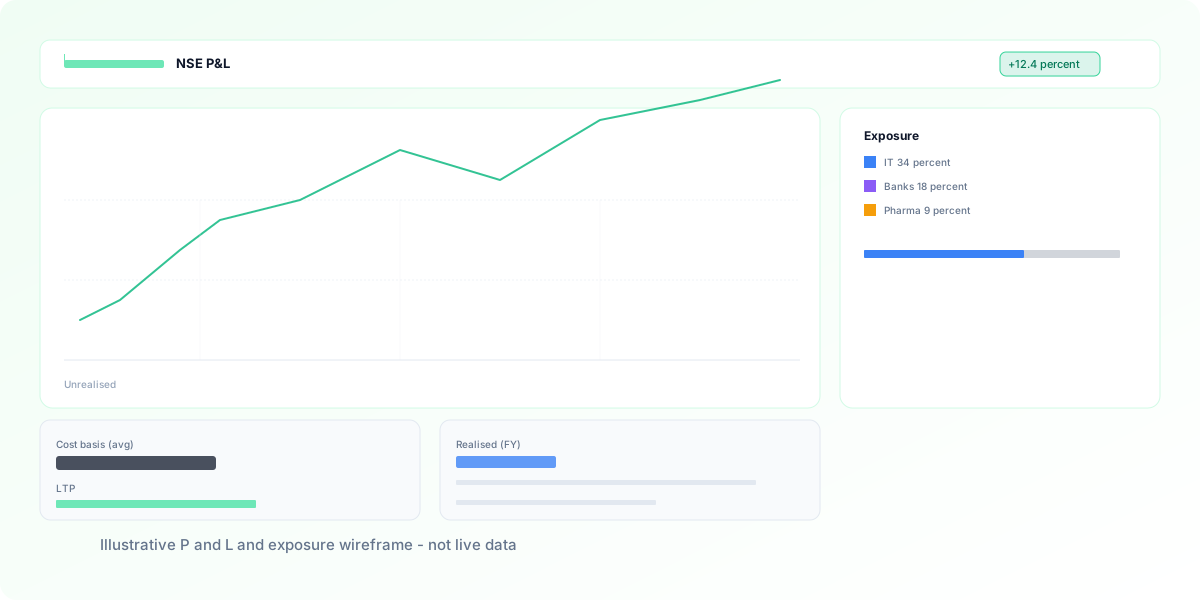
A single green line on a small-cap is how quiet concentration builds. Sensible investors pair P&L with exposure—by sector, by name, and against the rest of the portfolio that includes MFs, EPF, and global lists. SEBI’s investor education work keeps repeating the same structural point: understand what you own before you size it. A percentage gain in isolation does not say whether the win was skill, luck, or one narrative that can reverse faster than it took to build.
If you only remember one number after this article, make it: am I looking at a closed trade or a live position, and which price and cost definition produced the line? If you can answer that in one breath, the broker app and your tracker will stop arguing with each other—and you can argue with the market on purpose, not by accident.
Frequently asked questions
What is unrealised P and L?
It is the paper gain or loss on the shares you still hold, based on a market price and the cost of those lots. It becomes realised only when you sell (or the position is fully closed) on terms that the exchange and your broker will record in your contract note.
Why is my P and L in the broker app different from my spreadsheet?
Brokers can differ on average-cost method, how they treat stock splits and bonuses, whether fees and STT are folded into the cost, and the exact price they use for mark-to-market. Your job is to pick a rule, stick to it, and use the same contract notes as the ground truth, not a screenshot from a second screen.
Does the broker P and L include tax?
Usually not. STCG and LTCG in India are computed on your ITR; slabs and conditions change with the budget. Use broker numbers for the trading book; use a CA or the income tax portal for what you actually owe. Do not mix the two in your head the night before 31 July.
What is the difference between absolute return and a money-weighted return?
Absolute is a simple 'up from the start' story. A money-weighted or IRR-style return respects when you put money in and out. If you are adding to a small cap every month, the two numbers are supposed to be different, not evidence that someone is wrong.
Should I track sector exposure alongside P and L?
Yes, if the question you care about is 'how much of my net worth would move if a single story breaks.' A green P and L in one IT name can still mean dangerous concentration. Gains and exposure answer different questions.
Where does corporate action handling matter most?
In splits, bonuses, and mergers, your quantity and effective cost can change. Exchanges and companies publish the corporate action; your broker will adjust holdings. A tracker that stores lots by date and applies adjustments correctly is doing real work, not a cosmetic P and L line.
See everything in one place
Invesh brings stocks, mutual funds, PPF, NPS, EPF, and US stocks into a single dashboard with P&L and Artha for document import.