Portfolio Tracking
Risk, exposure, and concentration: what a portfolio should actually track
Beyond daily P and L: how to think about equity share, name concentration, and geography in one Indian household portfolio, with a light review habit.
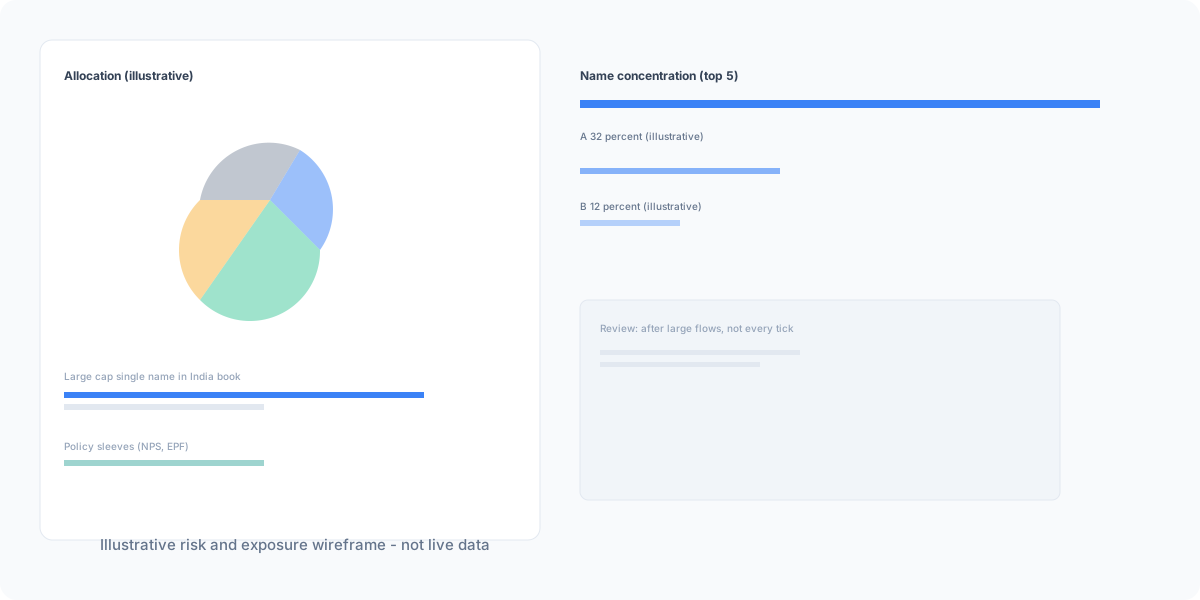
Risk in retail conversation often means volatility this week. In a household balance sheet, risk is a broader word: the chance that your standard of living depends on a single story—one employer, one sector, one country—in a way you never chose on purpose. Exposure and concentration are the measurement of that; they are not predictions of the next crash, they are maps of where you are today.
Diversified in apps, concentrated in the economy
Fifteen equity funds can still be one theme; five Nifty-adjacent ETFs can still be one country factor. SEBI’s investor education and plain-language asset allocation work from the industry keep repeating: diversification is not the same as many names, it is independence of drivers. Mint and Economic Times personal finance columns in India often land on the same home bias point: most of us earn in rupees, spend in rupees, and invest a growing slice in the same corporate earnings pool because it feels familiar. That is not a sin; it is a concentration to see.
Three levers: asset, geography, name
- Asset class — how much sits in market-linked claims versus salary-backed EPF or PPF versus a debt fund or a savings line you will actually draw on as cash.
- Geography — a US tech sleeve in dollars can be a good part of a plan; it is still a second country factor in your life.
- Name — a single stock with a double-digit share of liquid net worth is a policy lever, not a moral test.
CFA Institute material and the Bogleheads wiki in the West state the same math in plain English; the Invesh angle is the practical one. Can you recompute your sleeves in an hour on a quiet Sunday, or are you still guessing in five different apps?
Thresholds as a personal law, not a law for everyone
Some families use rules like: any one name above a chosen share of our risk capital needs a one-page thesis before the next top-up. Others do not use a number at all and only look at a quarterly portfolio pie chart. The tooling is the same; the governance is up to the household. Rebalancing in a tax-sensitive system has a cost, so a blog line cannot replace a chartered account for your STCG and LTCG choices in a given year.
Cadence: flows first, not CNBC
A lump inflow or a sudden need for cash is a day to reopen the stock book and the full book, not because the Nifty moved fifty points but because your life changed.
A quiet habit that works for many salaried teams is: once a quarter, on a day you are not in a work crisis, look only at sleeve lines first—equity against EPF+PPF+NPS, India against a US sleeve if you have one, and the top few names in direct equity—before you open a new fund note or a hot tip. The Nifty is a sideshow on that day; the concentration of your story in one sector and the mismatch between your paycheque and the book are the act. A one-date note, whether you keep it in a file or in your portfolio view, is enough. The app exists to turn a fog of balances into at most one or two actions: trim, top up a boring sleeve, or do nothing if the last quarter’s plan is still the truth.
Where Invesh is trying to help
Concentration is a chore on a spreadsheet; it is what makes a health check useful when Indian listed equity, US names, and policy sleeves sit in the same dashboard. You still supply the why. The app supplies the add-up.
Risk and exposure are the adult part of a portfolio meeting; the return chart is the loud part. Track the second half in one place and the first meeting of the quarter is usually shorter and kinder.
Homework for the first time you do this: write one number per sleeve—India direct equity, India mutual funds by category, the EPF+PPF+NPS Tier I tranche, and a US line if you have one. Avoid double–counting the same name through both a fund and a stock unless you are doing that on purpose. If the row in your head and the dashboard row are within a band you can defend at dinner, the habit is working; the index does not need to move to make that afternoon useful.
Frequently asked questions
If I have twenty mutual funds, am I diversified?
Maybe, but not because of the count. You may be holding the same index three times, or the same three banks in three active funds. Diversification in the sense that matters is low correlation between *economic* stories, not a long list of logos.
Is one stock at thirty percent of my liquid net worth always wrong?
It is a policy call. Some founders keep that shape on purpose. The wrong outcome is the one you *sleepwalk* into after a two-year run without a decision, not a particular percentage out of context.
How often should I look at exposure?
A quarterly glance is enough for many people; a fresh look after a large flow (bonus, sale, inheritance) is a must. A daily number for total equity share is a recipe for over-trading, not for governance.
Does my EPF and NPS change my equity exposure even if I never see a demat for them?
Yes. A Tier I NPS equity sleeve and a large EPF *provident* balance with no listed equity at home is still a shape of risk, just not one the broker app shows. The full view belongs in a household portfolio layer.
What about my US account?
A global list is a separate *geography* and often a separate *currency* risk. Put it in the [same book](/us-stock-tracker) as the Indian MFs, not a second mental bank account, if you are asking how much of *us* is in a single market story.
Where do I get a single number for all of that?
A product like the [Invesh portfolio tracker](/portfolio-tracker) is built to [roll stock](/stock-portfolio-tracker), MFs, EPF, NPS, and US in one *rupee* line when the data is in. The thinking is still yours; the app only removes the 'let me add five app balances in my head' part.
See everything in one place
Invesh brings stocks, mutual funds, PPF, NPS, EPF, and US stocks into a single dashboard with P&L and Artha for document import.