Indian Investments
NPS Tier 1 vs Tier 2: what to track in each
A clear NPS tracking guide: how Tier 1 and Tier 2 differ, what to log for each, and how 80CCD fits in—without conflating two different accounts in one.
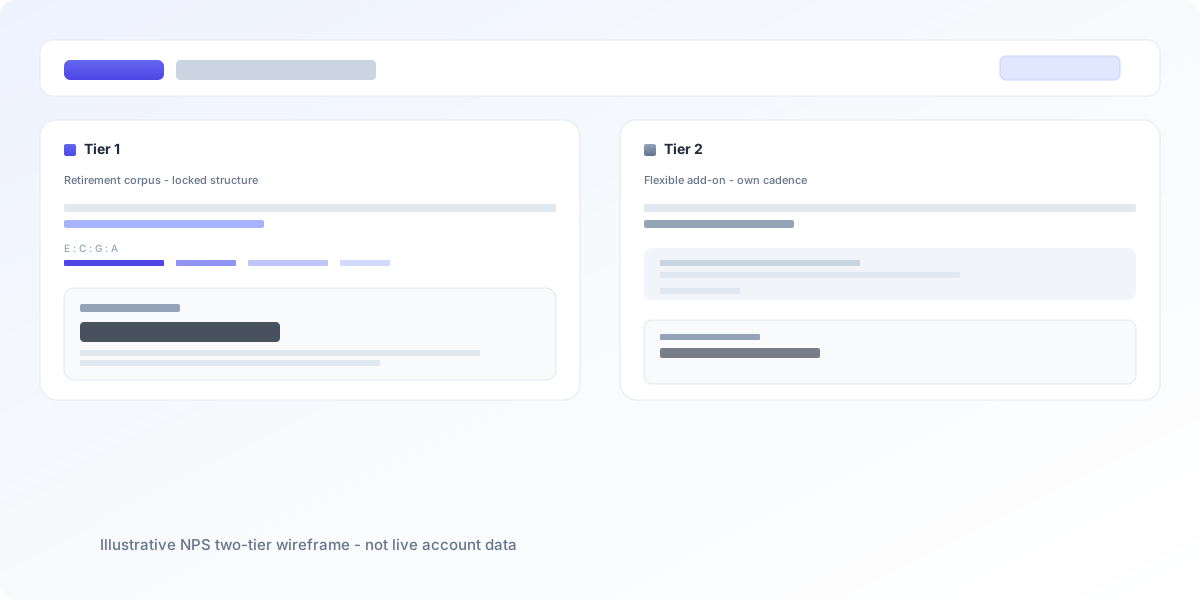
The National Pension System (NPS) is often introduced as a single product, and then the app quietly shows you two different balances. Tier 1 is the retirement sleeve most salaried employees are enrolled into, while Tier 2 is an optional, more flexible add-on. When you conflate the two, you get three recurring mistakes: you forget how illiquid Tier 1 is, you ignore scheme mix inside Tier 1, and you muddle the 80CCD story at tax time. A cleaner habit is to treat the tiers as two accounts in one system—each with its own purpose, and each worth tracking in its own column.
What Tier 1 and Tier 2 are actually for
Tier 1 is the anchor of NPS for most members. The idea is to accumulate until and through retirement with a regulatory wrapper that emphasises a long time horizon, employer co-contribution in many cases, and rules about how money eventually converts into a pension and lump sum at exit. The trade-off in plain language: you are buying structure and governance for retirement, not a high-turnover broking account. That is why a healthy Tier 1 view is not just "NAV is up" but also am I in the E/C/G/A mix I signed up for six years ago, or have I quietly drifted?
Tier 2 is optional and is often sold as a simple side pocket: still within the NPS family of accounts, but without the same retirement-focussed design as Tier 1. People open Tier 2 when they want a disciplined second pocket without opening yet another app—but it is a mistake to assume Tier 1 and Tier 2 are interchangeable. From a tracking standpoint, you want two separate time horizons and two different uses of liquidity, even if the login screen is the same.
What to track in each tier
A useful Tier 1 ledger has four layers, even if the bank portal shows less:
- Money in: every contribution from salary, extra voluntary top-ups, and the employer’s share, noted by financial year and channel (payroll, bill payment, e-NPS) so you can see whether you are using the voluntary slots you care about. Limits and the interaction with Section 80CCD are announced from time to time; always read the year’s finance act summary before banking on a number.
- Schemes and allocation: the split you chose across the equity, credit, government, and alternative options the architecture allows, and the extent to which market moves have nudged that mix away from intent.
- Value: units applied to the latest NAV the scheme family publishes, summed across the basket—not a one-line round figure from an SMS.
- Rules that matter to you at a glance, such as the broad exit and partial access framework that applies in your case. These rules change; that is a reason to rely on a primary source, not a comment thread, when you are close to a withdrawal decision.
Tier 2, by contrast, usually matters for funding patterns and how much of your monthly surplus you are parking next to the locked Tier 1. Track contributions, the same scheme view if you use it, and a simple note of why you are adding—top-up, rebalance, or short goal—so Tier 2 does not silently grow into a second unplanned equity sleeve.
The tax map you should not muddle (high level)
Most investors only need a layperson map for Section 80CCD questions: a slice of the story sits alongside other retirement deductions, and there is a separate, additional path that often appears in the section marked 80CCD(1B) in tax literature. The labels move between assessment years, and the eligible amounts can change with the budget. The tracking habit that survives budget cycles is: separate the rupees you have actually remitted in Tier 1 in this financial year from the rupees you hope to book into a deduction, then reconcile with your Form 16 and your NPS trust statement. This article is not tax advice; a chartered accountant and the current circulars are the only sources for your return.
In practice, software helps when it shows contribution to date against the two conceptual buckets you are trying to fill, without pretending the law is a fixed ratio forever.
NPS next to PPF, EPF, and the rest of the book
Once NPS is visible as two sleeves inside one system, the next question is how it looks beside EPF, your PPF block, and the market parts of the family. A consolidated wealth view should not add Tier 1 and your equity MFs in one green line and call the job done; the point is to see that Tier 1 is a governance layer in your long arc, EPF a salary contract, and direct equity a tool for growth with volatility. The NPS investment tracker in Invesh is built to hold Tier 1 and Tier 2 in separate dashboards and still roll the pair into a single household number when you need it, alongside PPF, EPF, and listed assets in the portfolio tracker. If your pain is retyping CRA PDFs, Artha is there to read statements; if you are still comparing Invesh to a spreadsheet, the features page is the right map of what is automated and what is still in your control.
NPS rewards clarity more than cleverness. Tier 1 and Tier 2 are not a naming exercise—they are the difference between a retirement project and a side pocket. Track them the way the scheme already thinks about them: in two lines, in two columns, in one life.
Frequently asked questions
Is Tier 2 the same as Tier 1, just with another name?
No. Tier 1 is the long-term, retirement-focussed part of NPS. Tier 2 is optional, sits alongside Tier 1 in the same NPS family, and behaves more like a savings pot with its own access rules. They should be tracked in separate mental buckets, not merged into a single 'NPS' number in your head.
Which tier gets the 80CCD tax benefit?
In practice, the bulk of the discussion is about what you can claim under 80CCD for Tier 1 employee or voluntary contributions, and the additional voluntary slot under 80CCD(1B) when you top up. Tier 2 is generally not treated the same for deduction purposes; confirm the current year rules with a CA or the income-tax department site before filing.
Why track scheme allocation (E, C, G, A) separately in Tier 1?
NPS is not one anonymous balance. The split between equity, credit, government paper, and alternative assets drives risk and the path to retirement. You track allocation so you notice drift, not so you can day-trade your pension in a web portal.
Can I withdraw from Tier 1 any time I want?
Tier 1 is designed with retirement in mind, with structured exit and partial access rules that evolve over time. The exact conditions depend on age, how long you have been in the system, and current regulations; read the PFRDA or NPS Trust material for your situation rather than relying on a one-line app summary.
Do I need two separate spreadsheets for Tier 1 and Tier 2?
You can use one place as long as it shows two sub-ledgers: one line of sight for the locked retirement corpus, one for the flexible pot. A portfolio tool that already tracks both as independent sleeves saves you from summing NPS in your head next to PPF, EPF, and equity every quarter.
How is market value in NPS usually calculated for tracking?
Holders with unitised schemes multiply units by the latest net asset value (NAV) for each sub-account and add them. That is why a tracker that stores contributions and the scheme mix produces a far clearer picture than glancing at a one-line total in an SMS.
See everything in one place
Invesh brings stocks, mutual funds, PPF, NPS, EPF, and US stocks into a single dashboard with P&L and Artha for document import.