Indian Investments
How to track US stocks from India: USD, INR, and the full picture
Track US stocks from India: what to log in dollars vs rupees, how FX alters the story, and how to see one portfolio across US broker apps.
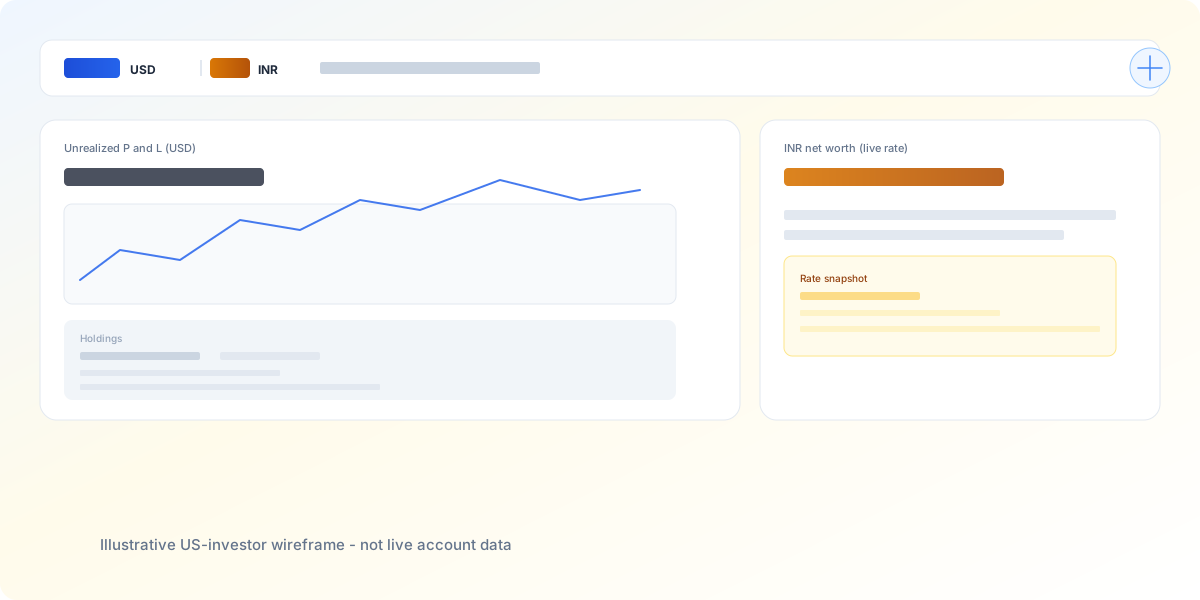
A US brokerage app will happily show a dollar gain on Apple or an ETF and call it a day. Your life, however, is in rupees, your tax return is in rupees, and your other goals—school fees, an EMI, retirement—are in rupees too. The gap between those two screens is not a sign that you are bad at numbers; it is a sign that you have not yet chosen a tracking rule that connects foreign currency, lots, and the exchange path your money actually took. This guide is that rule book at a high level, without turning into tax advice or a one-line remittance cap that will be outdated next month.
The tracking problem is really three app problems
Most new India-to-US stock investors do not have a return problem in year one. They have a state problem:
- The broker in the West is authoritative for quantity, order history, and corporate actions in the instrument's home currency.
- The bank in India is authoritative for the rupees you debited, the TT rate on that remittance, and the fees that did not all land in the first dollar you converted.
- Your own memory is authoritative for nothing, which is why a third surface—a ledger you trust more than a screenshot—matters on day thirty and day three hundred.
Tracking, then, is the discipline of building one reconciled world from those three. You are not after precision to four decimals on a Sunday; you are after a structure that does not break when the rupee has a bad month and your US positions have a good one, or the reverse.
The ledger: what a serious row should contain
Whether you use a product or a table, a useful line item for a US lot or an ongoing position usually records:
- Date and time in the time zone the broker used for execution, or at least the local trade date, so the right historical USD-INR is not guessed.
- Quantity, side, and the gross in USD before platform fees, then fees in their own column so the cost base is not silently optimistic.
- For funding: the INR that left your local bank, the rate the bank or payment rail applied, and any line items your broker labels as "conversion" or "spread" in USD, because those are part of the path your wealth took, even if the broker hides them in a subtotal.
- For income: dividends in USD and, where you care about compliance, a flag that the cash arrived in a broker balance versus was swept somewhere else. Idle USD cash in the broker is still part of your US return.
None of that requires a finance degree. It only requires a refusal to use "current balance" in an app as a substitute for "what I paid, when, and in which currency".
The two returns you should not confuse
First, the dollar story: How did the instrument move in its home market? That is the return your global equity manager might quote in a report. It answers whether you picked a decent sleeve for US exposure, ignoring where you were sitting on the map.
Second, the rupee story: If I marked everything to INR at a consistent time (say, 4 p.m. Mumbai) using a defensible source for USD-INR, what happens to my household net worth? That is the return that sits next to your MFs, your NPS Tier 1, and the flat you are still saving for. It is allowed to be lower than the dollar return in a year when the rupee strengthens, and that is not a "mistake"—it is a reality of being an India-based owner of foreign risk.
A tracker that shows both USD and INR in one view keeps you from celebrating a green line that was mostly a currency bet, or from panicking over a red rupee line on a year when the underlying business did fine. You still make your own call on which number you optimise for; you just do not conflate the two in your head at 11 p.m.
LRS and the annual remittance map (durable, not a headline)
Before you can invest abroad as a resident individual, your foreign currency usually flows through a route known as the LRS, which bundles many permitted uses of overseas money for retail households. Investment in equity abroad is a permitted use subject to the rules in force and your bank’s process, not a private agreement between you and a startup landing page. The number that often appears in public discussion is an aggregate cap per person per year; that cap is a policy tool and it changes over time, so the only defensible place to read the current one is a recent Reserve Bank of India circular, your bank’s outward remittance desk, and your CA.
Your tracking system does not need the annual limit typed into it as a field that goes stale. It needs a place to note, each year, that you used part of the envelope to fund a given account, and that a future top-up in another financial year is a fresh remittance, not a continuation of an old in-app balance.
Tie the US sleeve to the full Indian book
A US-only dashboard overweights tech concentration and underweights the illiquid, government-backed slices most Indian families already have in EPF, PPF, and half of NPS Tier 1. The moment you fold US holdings into the same household view as the rest of your Invesh book, the question flips from "is NVDA up?" to "what slice of my net worth is in global equity, and am I still comfortable?"
For ingestion, a manual CSV evening once a month is a fine ritual; if your patience runs out sooner, Artha can help pull trades from a broker file so you are not a human OCR machine. A quick scan of the features list tells you which import paths are live for which instrument types, so you do not promise yourself automation that a release note has not yet shipped.
Tracking US stocks from India is less about a clever formula and more about a persistent map: your money's path, in dollars and in rupees, in one house so you are not re-learning it every time the exchange rate moves. Do that, and the apps can stay as noisy as they like—you will still know what you own, and what it is doing in the currency that funds your life.
Frequently asked questions
Why is my US broker P and L in dollars different from my rupee wealth change?
A gain in the stock in USD and a gain in your net worth in India are two different questions. The first ignores which rupee you paid for each foreign currency unit. The second folds in how USD-INR moved between remittance, each trade, and when you look at the screen. Good tracking always keeps both in view.
What is LRS, and do I have to know it to track a portfolio?
The Liberalised Remittance Scheme is the regulatory channel through which resident individuals send money abroad for permitted purposes, including overseas investments in line with the rules. You should know that remittances for investing sit inside an annual per-resident cap that the RBI revises. For the exact number and the fine print, read the current RBI master direction; do not rely on a blog comment from two years ago.
Should I track one global account or one row per app?
If you use more than one platform, track each as its own account and then add them up. Mixing Vested, global broker, and a legacy U.S. account in one number hides fees, stranded cash, and the tax year in which a gain actually crystallised.
Do I need a spreadsheet, or is an app enough?
A spreadsheet is honest; an app is faster. The test is the same: can you list every lot with date, quantity, and the exchange rate you care about, and can you recompute both USD and INR value on demand? If yes, the container does not matter.
How do dividends complicate things?
Dividends land in the broker's USD cash, may be auto-reinvested, or may sit as idle cash that quietly drags your return. A ledger that only tracks price per share and ignores cash lines will mis-state total return.
Where does a domestic portfolio tracker help?
When the US sleeve is only one column next to MFs, NPS, and EPF, you stop treating global equity as a hobby account. A unified rupee-denominated net worth view, with US holdings converted at a consistent rule, makes allocation conversations honest.
See everything in one place
Invesh brings stocks, mutual funds, PPF, NPS, EPF, and US stocks into a single dashboard with P&L and Artha for document import.