Indian Investments
EPF passbook: how to track your balance and what the lines mean
A practical EPF balance tracking guide: UAN passbook, employee vs employer lines, interest credit, and when to go beyond a once-a-year download.
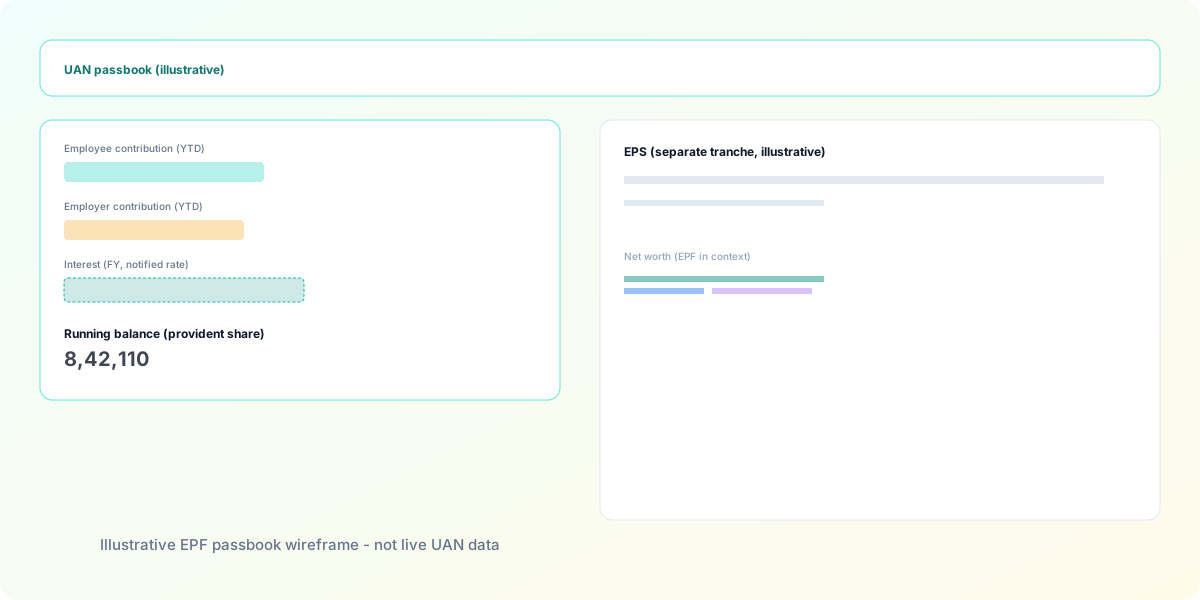
For many salaried households in India, the EPF line is a quiet giant on the balance sheet—bigger than the broker account, more stable than a single small-cap, and yet less watched than the mutual fund you opened in a app ad. The EPF tracker story at Invesh is simple: the UAN passbook is the ground truth, and a second brain in software only helps when it refreshes the same way you would update a passbook, not a fantasy.
What a UAN “balance” is made of
At a high level, the UAN (universal account number) ties you to a history of employment. Employee and employer contributions, interest declared by the government and notified in the EPF world, and sometimes arrears and arrear interest, show up in the passbook as a sequence of rows. A single headline number in an SMS may hide EPS allocation that you should not conflate with the provident portion when you think about a future pension versus a take-home payout.
High-level EPF and labour explainers in ClearTax or ET or similar are fine for the words; the rupees still come from EPFO. For inoperative accounts, thousands of Moneycontrol and HR articles and EPFO nudges have described the problem; your tracking habit is: reconcile the official balance before you add the line to a wealth sheet for the family.
Channels: passbook, UMANG, member portal
Most members today meet EPF in digital form first. The EPFO main site, UMANG, and the UAN member e-sewa flow are the usual channels; your employer’s pay slip and Form 16 also carry implied numbers you can cross-check. A tracker should store as-of date and source of each import so a June fix does not look like a stock split in the wrong year.
Interest credit as a year-scale event
The notified interest rate is set in the policy cycle, not in your dashboard settings. The important habit is to expect the credit as an annualisation step and to reconcile when EPFO says you have a restatement, not to invent 12 little rows of fake interest in your sheet because it looks smoother on a chart. When you are comparing EPF to a debt fund, remember: one is a salaried and governed system; the other is a SEBI fund. Both are allowed in a diversified life; neither replaces reading the scheme rules you actually belong to.
EPF in the Invesh household view
Tracking EPF in Invesh is a mirror: you or Artha bring a UAN statement, you confirm the split each year, and the number rolls into the portfolio view with MFs, NPS, and US sleeves so a single Sunday question—“how much of us is in a government-backed, relatively illiquid tranche right now?”—has an answer.
A short note for families with two earners: each UAN and each passbook is still individual for tracking purposes, but the house level decision—how much of the combined book sits in a salaried-style wrapper versus listed market risk—is a single conversation. Seeing both passbooks in one portfolio layer is how that question stops being a finger-in-the-wind at dinner.
When a second employer or a transfer complicates the story
A new job often means a new establishment ID under the same UAN; you want transfer to finish before you trust a single graph. HR forums that discuss inoperative accounts are a reminder, not a substitute, for a KYC and grievance flow on the EPFO side. In the tracker, flag anything that is still in “in transit” in the app so the family does not spend next year on the fiction that the balance was flat.
EPF passbook discipline is a low-frequency, high-signal activity: a few good downloads a year, a row of interest you can name, and a full portfolio line you never have to re-derive from a forgotten Excel tab. The EPFO is still the system of record. Invesh is the plan on top, not the law—and for most families, that is exactly enough.
Frequently asked questions
Is my EPF balance the same as the number I see in the UAN passbook one line before interest?
The passbook is a transaction trail: contributions from you and the employer, transfers between establishments, and then an interest credit for the year based on the notified EPF interest rate. Your running idea of the corpus should be the result of that trail, not a one-line SMS from a bank you half trust.
Where is the EPF passbook, apart from the EPFO site?
The Employees Provident Fund Organisation, UMANG, and the member portal for UAN are the usual public channels. Names and UIs can change; find the list on the [EPFO](https://www.epfindia.gov.in) help pages for the current year rather than a two-year-old screenshot thread.
Why does the interest not show up as twelve equal monthly posts?
In practice, interest in EPF is conceptualised and credited in line with the scheme; most members see it as a **year** effect, not a monthly bank-style accrual on the same screen as your salary. Track the **annual** credit in your own sheet if you are modelling the curve of the corpus, not a fake monthly compounding you invented in Excel.
What is EPS, and will it be mixed into my EPF number?
There is a pension (EPS) component in many salaried members’ set-ups alongside the EPF *provident* balance. The passbook layout separates what belongs where at a high level, but a household net-worth view that ignores EPS entirely can mis-state retirement income later. Reconcile with a CA if you are close to retirement—this article stays descriptive, not actuarial.
When do I need manual EPF tracking beyond the passbook?
When you have changed jobs with pending transfers, when a previous employer’s record is inoperative, or when your current employer has made an unusual adjustment. The passbook is a strong default; the edge cases are when your life does not look like a single, clean establishment ID anymore.
Can a tool like Invesh replace the EPFO portal?
No. Invesh is a tracker on top of **your** data: you can [log](/epf-tracker) the numbers you read from the official system or let [Artha](/artha) help with a UAN passbook style PDF, then [see the full book](/portfolio-tracker) with MFs, NPS, and equity. The law and the final balance still live in EPFO’s system of record—this app is a mirror for planning, not a government login.
See everything in one place
Invesh brings stocks, mutual funds, PPF, NPS, EPF, and US stocks into a single dashboard with P&L and Artha for document import.